
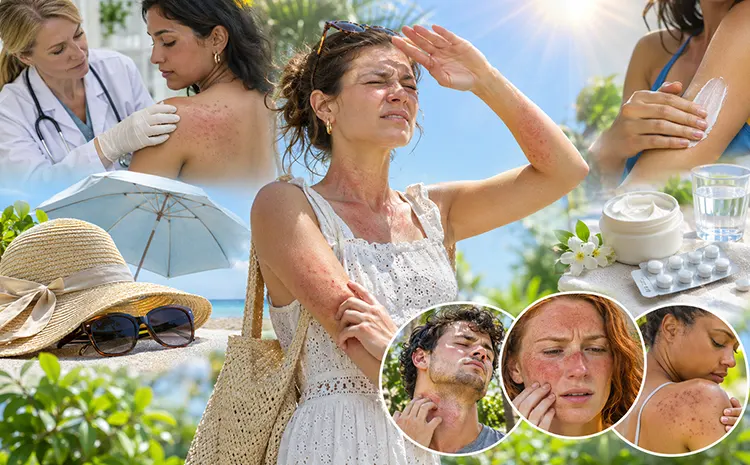
You’re looking forward to some sunshine; you go outside, and suddenly your skin itches, turns red, or develops small blisters. What initially feels like sunburn is sometimes something else: a so-called sun allergy. The term sounds straightforward, but medically it’s more of a collective term for various skin reactions to UV radiation. It doesn’t refer to a single condition, but rather several forms that can be triggered by sunlight.
What Is Meant by a Sun Allergy?
There is no such thing as a true “sun allergy.” The term describes various skin reactions caused by ultraviolet rays. Technically, a distinction is made between phototoxic and photoallergic reactions. Phototoxic reactions are not caused by allergies but result from a chemical reaction between light and certain substances. Photoallergic reactions, on the other hand, are triggered by processes of the immune system.
In phototoxic reactions, a photosensitizer makes the skin more sensitive to light. Even minimal exposure to UV light can then trigger burning redness or even blisters, specifically on the areas of skin that have been exposed to sunlight along with the triggering substance. Such triggers include natural substances like St. John’s wort or umbellifers, but also perfumes, skin creams, chemicals in cleaning agents or dyes, and medications.
Photoallergic reactions occur when certain substances on or in the skin trigger an immune response through exposure to UV radiation. These include certain antibiotics, some painkillers, blood pressure medications, antimalarials, diuretics, and certain neuroleptics, but also celery, parsley, citrus fruits, perfumes, and cosmetic products. These reactions can be triggered by UV-A radiation. This means they can occur not only outdoors in direct sunlight but also, to some extent, in enclosed spaces, because window glass partially transmits UV-A radiation.
What Types of Sun Allergy Are There?
The term “sun allergy” encompasses several forms of skin allergy. The symptoms that occur depend on the specific type of skin reaction.
Polymorphic Light Dermatosis (PLD)
Polymorphic light eruption is by far the most common form and what many simply know as “sun allergy.” It most frequently first appears in women between the ages of 20 and 40, but also occurs in men. Typically, the first symptoms appear a few hours to several days after sun exposure. The symptoms subside when the skin is no longer exposed to the sun.
Typical symptoms include intense itching in sun-exposed areas, as well as skin rashes with blisters, wheals, and widespread redness. It is precisely this combination that makes polymorphic light eruption (PLE) so unpleasant for many: the skin is visibly irritated and often intensely itchy.
Mallorca Acne
Mallorca acne often appears at the beginning of intense UV-A and UV-B exposure. The body’s “sun terraces,” such as the décolletage, shoulders, arms, and face, are particularly affected. Acne-like skin changes develop there, including red spots, nodules, papules, and intensely itchy welts. UV-A and UV-B exposure. The body’s “sun terraces,” such as the décolletage, shoulders, arms, and face, are particularly affected. Acne-like skin changes such as red spots, nodules, papules, and intensely itchy welts develop there.
The exact cause is not entirely clear. One explanation is that ingredients in cosmetics, such as fats and emulsifiers, trigger skin reactions under strong sunlight. Other studies consider Mallorca acne to be a mild form of polymorphic light eruption. UV-A rays are considered particularly relevant because they penetrate deep into the skin. UV-A rays, because they penetrate deep into the skin.
Light Urticaria (Solar Urticaria)
Solar urticaria is a rare form of hives. Those affected are sensitive to a specific wavelength range, most commonly visible light and UV-A rays. The increased histamine release causes wheals, as if the skin had touched stinging nettles. Because light clothing is often translucent, even covered areas of the body can be affected. UV-A rays. The increased histamine release causes hives, as if the skin had touched stinging nettles. Because light clothing is often translucent, even covered areas of the body can react.
A typical characteristic is the rapid onset: symptoms appear within minutes and usually disappear within one to two hours once the affected person gets out of the sunlight. In cases of strong sunlight, shortness of breath, dizziness, nausea, and even anaphylactic shock can also occur.
Chronic Actinic Dermatitis (CAD)
Chronic actinic dermatitis is one of the most severe forms of photoallergy, but it is very rare. Affected individuals react to specific wavelength ranges with intensely itchy, thickened, and inflamed skin lesions that do not simply disappear but can persist permanently.
What makes it particularly distressing is that people with CAD can react not only to UV light but also, in some cases, to artificial light and normal daylight. The condition primarily affects middle-aged or older men. The disease can react not only to UV light but also, in some cases, to artificial light and normal daylight. It primarily affects middle-aged or older men.
Photoallergic Drug Reaction
If medication, in combination with sunlight, causes redness and hives on the skin, a photoallergic drug reaction may be the cause. In this case, a photosensitizing substance enters the skin via the bloodstream and triggers the reaction there when exposed to light. Several days can pass before the reaction manifests. This form of reaction does not occur in everyone, but only in people whose immune system has developed an allergy to the medication.
Photoallergic Contact Dermatitis
Here, substances on the skin, in combination with UV-A rays, trigger the reaction. These can be, for example, certain sun protection factors in sunscreens or oils. The skin reddens and thickens, it itches intensely, and within a day, nodules and blisters can develop; sometimes the skin also peels. Initially, the reaction is often limited to the affected area, but it can spread over the entire body. If the trigger is avoided, the skin changes usually subside quickly. UV-A rays trigger the reaction.
It’s also important to note that symptoms appear after 12 to 72 hours. This delay is precisely why this form of allergy often seems so difficult to grasp in everyday life. Once a person is sensitized, the reaction generally recurs throughout their life whenever the allergen comes into contact with or enters the body again, especially in combination with sunlight.
People with sensitive or reactive skin should carefully select skincare products, as certain fragrances and ingredients can cause irritation. Following a skincare routine for sensitive skin can help them make more informed product choices.
Is Sun Allergy a True Allergy?
Whether “sun allergy” is truly an allergy is not scientifically definitively established. One explanation suggests that UV rays transform a harmless, naturally occurring substance into an allergen that activates the immune system. Another theory posits that sunlight causes the formation of free radicals in sensitive skin, which damage cells and thus trigger the symptoms. However, conclusive evidence for both theories is currently lacking. UV rays can transform a harmless, naturally occurring substance into an allergen that activates the immune system. Another theory suggests that sunlight causes free radicals to form in sensitive skin, damaging cells and thus triggering symptoms. However, conclusive evidence for both theories is still lacking.
What Helps Quickly Against Sun Allergy?
If your skin reacts, the most important immediate measure is quite simple: get out of the sun and into the shade. In the days following a rash, sun exposure should be avoided as much as possible. If that’s not possible, long pants, long-sleeved tops, a hat or cap, and consistent UV protection with sunscreen with a sufficiently high sun protection factor will help. These options can also alleviate the symptoms: UV protection with sunscreen with a sufficiently high sun protection factor. These options can also alleviate the symptoms:
- Cooling: Ice, cooling pads, moisturizing creams such as after-sun lotion or aloe vera, and cooling compresses with quark (a type of soft cheese) can relieve itching. The cold causes the blood vessels to constrict, and swelling can subside.
- Cortisone creams: These can usually suppress inflammatory skin reactions. However, their use should be discussed with a doctor beforehand; some require a prescription.
- Antihistamines: As ointments or tablets, they block the effects of histamine and can alleviate itching. In cases of frequent polymorphic light eruption (PLE), an antihistamine can even be taken three days before the trip and then throughout the entire vacation, but only after consulting a doctor.
- Beta-carotene: Can help some sufferers alleviate symptoms, but must be taken eight to twelve weeks before sun exposure. Smokers should not take beta-carotene because it increases their risk of lung cancer.
- Vitamin E: Sunscreens containing the vitamin E precursor pro-tocopherol, in particular, can inhibit inflammation and provide relief.
- Get a diagnosis: If the skin reacts repeatedly, the cause should be medically determined so that the reaction can be treated specifically and prevented.
- Phototherapy / UV hardening: UV hardening: In cases of photoallergic reactions, a desensitization effect can be achieved under medical supervision through repeated, controlled UV irradiation. This “hardening” should only take place under medical supervision. UV irradiation can induce a habituation effect. This “hardening” should only take place under medical supervision.
Gentle moisturizing products may help relieve dryness and discomfort associated with irritated skin. Understanding how to care for dehydrated skin can also help readers maintain their everyday skincare routine.
How Can You Prevent a Sun Allergy?
To prevent this from happening in the first place, one thing is key: gradually acclimate your skin to the sun. In addition, always apply sufficient sunscreen with a high sun protection factor and avoid the intense midday sun. This not only helps prevent sun allergies but also reduces the risk of skin cancer.
Frequently Asked Questions About Sun Allergy
1. What Is Meant by a “Sun Allergy”?
The term “sun allergy” is not medically precise. It describes various skin reactions to sunlight, especially to the sun’s UV rays. The most well-known type is polymorphic light eruption (PLE), in which the skin itches and shows skin changes after sun exposure. UV rays from the sun. The most well-known type is polymorphic light eruption (PLE), in which the skin itches and shows skin changes after sun exposure.
2. What Types of Sun Allergy Are There?
Polymorphic light eruption (PLE): Most common form with itchy redness and rash.
- Solar urticaria: Rapidly appearing wheals caused by UV or visible light. UV or visible light.
- Photoallergic contact dermatitis: a reaction to the combination of light and certain substances on the skin.
- Chronic actinic dermatitis: Rare, persistent light reaction.
3. What Symptoms Occur With a Sun Allergy?
Typical symptoms include severe itching, redness, hives, blisters, or a rash on sun-exposed areas. These can appear hours to days after sun exposure, depending on the type of reaction.
4. What Triggers a Sun Allergy?
Besides UV rays, certain medications, plant substances, cosmetics, or chemical compounds can make the skin photosensitive or act as photoallergens. Those affected then react more strongly to sunlight. UV rays can cause certain medications, plant substances, cosmetics, or chemical compounds to make the skin photosensitive or act as photoallergens. Those affected then react more strongly to sunlight.